

 |
|
|
|||
Our Pages
ABOUT CONSTITUTIONAL MEDICINE
|
What is it?
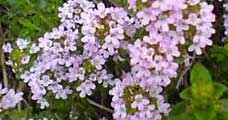
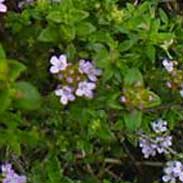
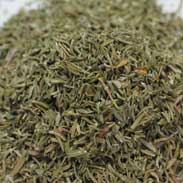
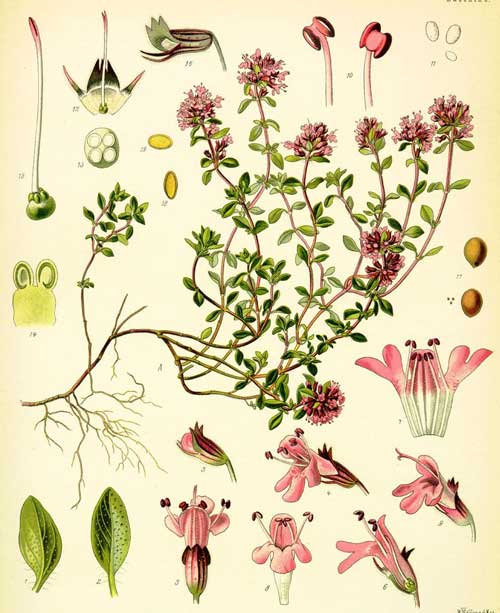
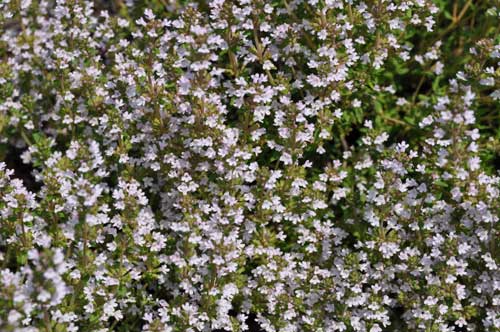
The dried leaves of Thyme, the familiar, low growing, woody, long-lived shrub with its distinctive scent. Thyme is a tough little plant that may grow straggly under difficult conditions but is likely to survive nevertheless.
In traditional medicine Thyme has first and foremost been a remedy for coughs that are dry, unproductive or painful, Thyme has a way of softening and loosening the cough to help the body do, with much less effort and discomfort, what it had been trying to achieve by coughing in the first place. Thyme also has a potent antimicrobial effect which speeds the resolution of infections in the lungs. ~ Thyme’s other traditional uses include:
M Grieve writes 'the name Thyme, in its Greek form, was first given to the plant as a derivative of a word which meant 'to fumigate,' either because they used it as incense, for its balsamic odour, or because it was taken as a type of all sweet-smelling herbs. Others derive the name from the Greek word thumus, signifying courage, the plant being held in ancient and mediaeval days to be a great source of invigoration, its cordial qualities inspiring courage' One renowned folk healer of recent times has been the French herbalist Maurice Messegue. He had this to say about Thyme. 'From my long years of experience as a herbalist I can appreciate Thyme because of its antiseptic qualities; its smell destroys viruses and bacteria in the atmosphere as it destroys infectious germs in the body. I do not know of any infection that cannot be mitigated if treated with this precious herb. It is an excellent weapon against epidemics and much cheaper than other methods of controlling them'. N Culpepper writes that Thyme is 'a noble strengthener of the lungs, as notable a one as grows, nor is there a better remedy growing for whooping cough. It purgeth the body of phlegm and is an excellent remedy for shortness of breath. It is so harmless you need not fear the use of it... it is excellent for those that are troubled with the gout and the herb taken anyway inwardly is of great comfort to the stomach' King's Dispensatory writes Thyme is tonic, carminative, emmenagogue, and antispasmodic. The cold infusion is useful in dyspepsia, with weak and irritable stomach, and as a stimulating tonic in convalescence from exhausting diseases. The warm infusion is beneficial in hysteria, dysmenorrhoea, flatulence, colic, headache, and to promote perspiration. Occasionally the leaves have been used externally, in fomentation. The oil is valuable as a local application to neuralgic and rheumatic pains; and, internally, to fulfil any of the indications for which the plant is used. It forms a good preparation for nervous and spasmodic diseases of children. It may be given in teaspoonful doses to a child 3 years old, repeating it 3 or 4 times a day, sweetening and diluting it, if desired. A strong infusion of the Thyme slightly sweetened, is a valuable remedy for whooping-cough, convulsive and catarrhal coughs, and stridulous sore throat, the favourable result occurring at the end of a very few days. The British Herbal Pharmacopoeia (BHP) describes the actions of Thyme as a carminative, spasmolytic, antitussive, expectorant, bactericidal, anthelmintic, astringent' says it is specifically indicated for pertussis (whooping cough) and bronchitis and also for dyspepsia, chronic gastritis, asthma, diarrhoea in children, enuresis (bedwetting) in children, laryngitis, tonsillitis as a gargle. The BHP recommends a dose of 1-4 grams or by infusion (A well-heaped tsp is about 2.5 grams, a rounded tsp closer to 2 grams) and 2-6mls of the 1:5 tincture and suggests it may be combined well with Lobelia for asthma and with Wild Cherry bark and White horehound for pertussis.
~ Essential oils in Thyme (notably Thymol) are well established to have potent anti-biotic and anti-fungal properties. A broad spectrum of activity against 7 different strains of gram-positive and gram-negative bacteria have been observed (Shapiro S, Meier A, Guggenheim B. Oral Microbiol Immunol 1995;10(4):241-246) ~ The authors, titles and the 'where-and-when' published of the remarkable number of nearly 800 further studies and articles on Thyme are listed in a PDF found here
For some years now, against this proven and safe way of herbalism, there has been a rising tide of excessive caution and scare-mongering in many parts of the world. The same authorities that, not so long ago, decried herbal medicines as ineffectual, have now taken up a different adversarial position; that they are dangerous substances that should only be prescribed by Doctors, who of course have zero training in them. Unfortunately, the same unnecessary fear and worry has crept into many natural health websites and popular publications on herbs. Herbs that we have safely used for thousands of years, that have no reports of adverse reactions in the medical literature despite widespread use by millions of people, are suddenly described as contraindicated because of something that should have been seen as completely unimportant, or at the utmost a merely theoretical concern, such as a laboratory study on one of the herb's constituents to use an all too common example. I wonder sometimes if the writers of such articles feel that the herb will be more deserving of respect if it is thought to be a little bit dangerous, in other words more like a drug than something that has simply come out of the earth and been used by ordinary people for generations beyond count. There is just so much misinformation about herbal medicine on the internet now. Ludicrous claims and cautions abound in equal measure; it seems like one group are trying to make money out of the public whilst the other are busily trying to scare them off. I have to believe that the kind of reader who takes the time to read pages on herbs that are as extensive as this one is much less likely to be swayed by marketers or misinformers. I hope that you will keep your wits about you if you get conflicting opinions from people who have never really got to know these herbs, who have never worked with them, or learned how to use them safely and effectively. I want to remind you that the reason that herbs can never be patented and owned by any individual or corporation is because they are, and always will be, the People's medicine. They belong to all of us and it is my great hope in sharing this work that you will learn how to use them wisely for yourself, and the people you care for. Be safe, but do not be afraid.
I have had some excellent experiences with the use of Thyme for people with the severe and stubborn bronchitis. Whenever I think about Thyme I am reminded to 'never underestimate the little guy' as the simple fact is that I have seen for myself how these tiny leaves pack enough punch to knock out infections that have defied repeated courses of the most potent antibiotics that were available at the time! It should be expected that Thyme will initially make people cough more rather than less at first but note how it can quickly change the cough from a dry, irritating, unproductive and exhausting ordeal to becoming a looser, 'wetter' more productive and much easier cough. Thyme has other great applications, no doubt, but it is in this transformation of a stuck chest condition into one that moves up and out that has given me the greatest respect for its healing power. If you who are reading this are studying herbal medicine or if you have your own reasons to want to understand this plant ally at a much deeper level then I warmly encourage you to take a tsp of dried Thyme from your kitchen panty, place it in a cup of hot water for 5 minutes or so, strain and then drink some of the resulting Thyme 'tea' with a quiet and attentive mind. This old way of experiential learning can do more to show you the 'action' of the herb than any amount of academic study. You have to try it for yourself to see but having done this experiment myself and with colleagues and students I think you will find it to be a strongly 'activating' herb. Your body will notice its arrival! Further to that, if you would like to learn more about the ancient art of pulse testing, a simple but powerful way to ask the intuitive intelligence of the body for its responses to a herb by feeling the pulse whilst giving a tiny dose by mouth, read here I have come to use Thyme in quite modest amounts in my formulas. I feel that a little goes a long way and that just a ml or two in a combined mixture will give its potent actions. For example, this is a typical formula from the article on bronchitis and pneumonia found here
The above liquid extracts are combined into a formula to make 560mls. This will just fit in to a 500ml amber pharm round bottle. These are some of the most important herbs in Nature to improve the health of the lungs. They all work in different ways but combining them into a formula like this gives a better result than could be achieved by using them individually Thyme combines particularly well with Golden Rod and Elder for clearing infections, with Mullein and White horehound for bad coughs and with Elecampane and Licorice root for deep lung troubles. Its flavour can be somewhat mitigated and its action augmented by Aniseed. Acute bronchial infections and chronic stuck coughs yield best to a strong tea of Thyme made in the morning and then sipped through during the day. People have varying sensitivity to Thyme, some can take very large amounts without any trouble whereas others would find the taste and aroma of it too overpowering to use for long. If you are sensitive to the smell or taste of it, you can still be sure that just a few tsps of Thyme (e.g. 3 or 4) in a litre of water steeped whilst covered for a good 10-15 minutes will be ample to get its strength. This could be taken in small doses throughout the day and it is certainly appropriate to add others herbs (or honey) as available and as desired for taste and effect. If you love the taste and smell of Thyme then it will not hurt, and may help, to take it in larger quantites and you might even want to do a steam inhalation with it whereby you bring it to the boil in a covered pot, then leave it to cool for a few minutres, pour into a bowl and wrap a towel around yourself and the steaming Thyme. Being careful not to have the steam too hot, and allowing it to escape through the towel if it is, but slowly and fully inhaling the steam of the hot Thyme tea to reach deep into a stuck chest infection. Most people find that their condition noticeably improves the first day they follow this simple program. Thyme is a safe herb so keep the treatment going as long as necessary. Thyme can also work particularly well in a bath. A handful of dried Thyme wrapped in some muslin cloth or whatever is to hand and placed in the bath will make a potent, aromatic and therapeutic bath to open the lungs and ease aches in the muscles. It has a paradoxical effect of being both relaxing to the body and stimulating to the mind...
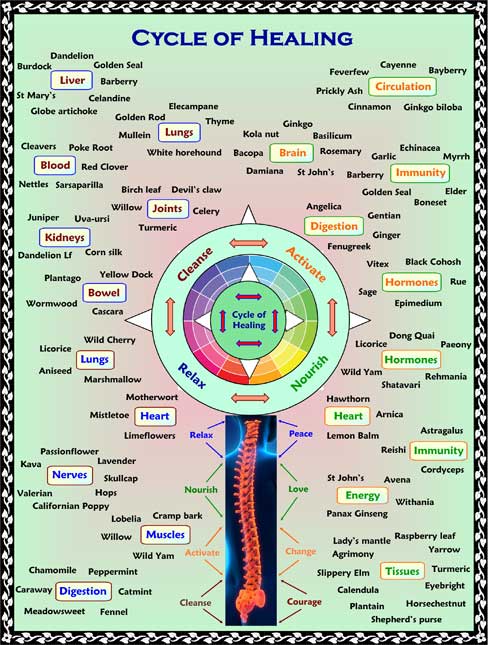
Much of the information here about the traditional uses of Thyme is consistent with the model of thinking whereby one may treat problem A with plant B. There is value in this approach, especially in how it helps us pass on useful knowledge to one another, but it falls short in one vital area; and that is that people are not all cut from the same cloth! Something that works brilliantly for one person may do less for another -- why is this? Part of the reason is that people vary in their constitutions as to whether they are either hotter or cooler and, at the same time, either dryer or damper. This useful and rather fascinating subject is introduced further here Another big part of using the right herb when it is most needed comes from understanding the need to treat what is going wrong for the person that had led up to their getting a health condition. In this light, Thyme can particularly offer its benefits when a cleansing action is needed in the 'cycle of healing', more about this here
Please understand that I cannot advise you, including on products or dosage, without seeing you in person in my clinic but for ideas
on how you might find a good herbalist in your area read here |
|


 TOP
TOP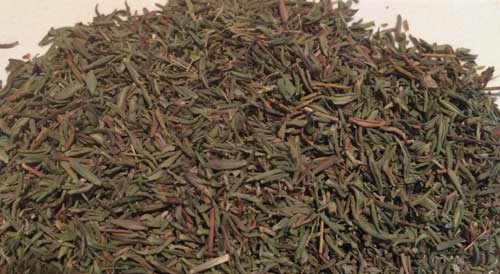
|


© 2011 R.J.Whelan Ltd