

 |
|
|
|||||||
Our Pages
ABOUT CONSTITUTIONAL MEDICINE
|
What is it?
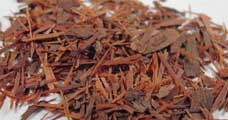
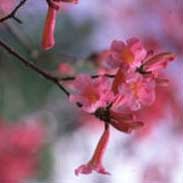
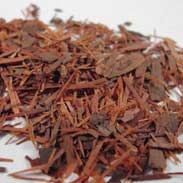
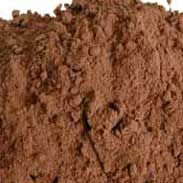
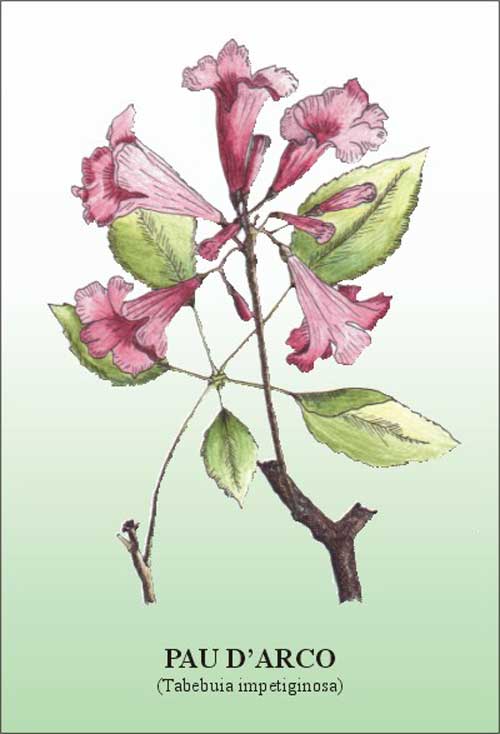
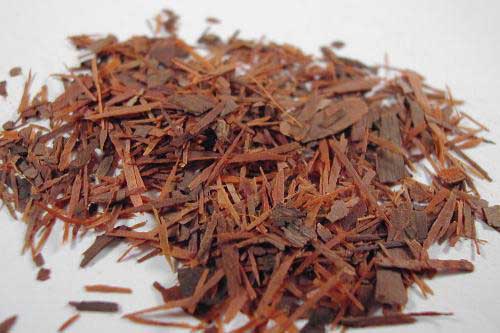
The part used in herbal medicine is the reddish/purple splintered inner bark that has a strong, intense woody flavour when brewed into a decoction or taken as a tincture. Pau D’arco or Taheebo are some of the common names for a tree that grows at high altitude in the Andes of the South American rainforest.
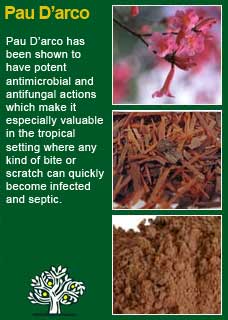
Pau D’arco was used as one of the main medicines of the Incas for at least a thousand years. From their tradition, the Callawaya tribe still extensively uses the herb to this day. It is also still widely used in Bolivia, Brazil, Paraguay and Argentina and has developed considerable popularity further afield in recent years. The historical use of Pau D’arco strongly revolves around its ability to treat external skin infections, illnesses and wounds. Pau D’arco has been shown to have potent antimicrobial and antifungal actions and these would have made it extremely valuable in the tropical setting where any kind of bite or scratch can very quickly become infected and septic. Pau D’arco’s use as an internal medicine is steeped in mythology and folk-lore. It has been historically regarded that it has the power to cure or prevent cancer as well as work for other such serious conditions as snake-bites, leprosy, syphilis, dysentery, diarrhoea and fevers. In the 1960s a popular Brazilian news magazine reported cases of 'miracle cures' of terminal leukaemia and cancer following the use of Pau D’arco tea and the bark was dispensed from hospitals in Sao Paulo for treating leukaemia, diabetes, ulcers, rheumatism and cancer. Sales into the US passed 200 million dollars a year not long after and it remains very popular in many quarters to this day.
~ Pau D’arco bark is rich in lapachol (between 2-7%), a substance that studies have shown to be active against lympocytic leukemia in mice and cultured tumour cells. Lapachol has demonstrated significant antitumour activity in the laboratory (Keppler D, Fauler J, Gasser T et al. Adv Enzyme Regul 1985;23:61-79) ~ Lapachol has also been demonstrated to be effective against penetration and infection of the deadly parasite Schistosoma mansoni (Pinto AV et al. Trans R Soc Trop Med Hyg 1977;71(2):133-135) ~ A phase 1 clinical trial using Lapachol was initiated in 1967 at the Baltimore Cancer Research Centre. The trial involved 21 patients with leukemia, each of whom were given capsules containing 0.25 or 0.5 grams of Lapachol. The trial was stopped prematurely because prolonged prothrombin times were observed at the high oral doses required to test for anti-tumour activity. These doses also resulted in nausea and vomiting (Block JB, Serpick AA, Miller W et al. Cancer Chemother Rep (2)1974;4(4):27-28) ~ Presciption of Lapachol (20 to 30mg/kg/day) caused shrinkage of tumours and reduction in pain for 9 patients with cancer who participated in a small clinical trial. Three patients ceased the treatment because of nausea and vomiting, the other patients had no significant side effects. Three patients experienced complete remission (De Santana CF Pessoalins LJ, Asfora JJ et al. Rev Inst Antibiot (recife) 1980/1981;20:61) ~ The authors, titles and the 'where-and-when' published of nearly 50 further studies and articles on Pau D'arco are listed in a PDF found here
For some years now, against this proven and safe way of herbalism, there has been a rising tide of excessive caution and scare-mongering in many parts of the world. The same authorities that, not so long ago, decried herbal medicines as ineffectual, have now taken up a different adversarial position; that they are dangerous substances that should only be prescribed by Doctors, who of course have zero training in them. Unfortunately, the same unnecessary fear and worry has crept into many natural health websites and popular publications on herbs. Herbs that we have safely used for thousands of years, that have no reports of adverse reactions in the medical literature despite widespread use by millions of people, are suddenly described as contraindicated because of something that should have been seen as completely unimportant, or at the utmost a merely theoretical concern, such as a laboratory study on one of the herb's constituents to use an all too common example. I wonder sometimes if the writers of such articles feel that the herb will be more deserving of respect if it is thought to be a little bit dangerous, in other words more like a drug than something that has simply come out of the earth and been used by ordinary people for generations beyond count. There is just so much misinformation about herbal medicine on the internet now. Ludicrous claims and cautions abound in equal measure; it seems like one group are trying to make money out of the public whilst the other are busily trying to scare them off. I have to believe that the kind of reader who takes the time to read pages on herbs that are as extensive as this one is much less likely to be swayed by marketers or misinformers. I hope that you will keep your wits about you if you get conflicting opinions from people who have never really got to know these herbs, who have never worked with them, or learned how to use them safely and effectively. I want to remind you that the reason that herbs can never be patented and owned by any individual or corporation is because they are, and always will be, the People's medicine. They belong to all of us and it is my great hope in sharing this work that you will learn how to use them wisely for yourself, and the people you care for. Be safe, but do not be afraid.
I am confident that Pau D’arco really is a powerful and potent medicine but sadly I have a problem with Pau D’arco in that I think it is very hard for most people to take very much of it for any length of time. If you grew up familiar with the taste, or if you were sick enough that you would take anything, then I think it could be a different story but for most people this is a herb that can pose some real issues with compliance. When I look at the literature on Pau D’arco I can see that the traditional dose used by Indian doctors was very high, around 20grams in a litre of water a day. This is probably the kind of level required but it would be just too challenging for many people. Partly because of the taste and also, as shown by studies from the U.S national cancer institute, Pau D’arco may indeed prevent, delay or treat cancer but the oral doses needed to reach useful levels in the blood can cause side effects such as anaemia, diarrhoea, dizziness, nausea and vomiting. It may be that Pau D’arco really is a genuine medicine that can assist with the great fight against cancer but I would be very cautious before trusting in capsules of Pau D’arco that bypassed the traditional method of boiling up a big handful of it on a daily basis. It takes an awful lot of capsules to reach 20grams a day (maybe upwards of 40 if they each contain about half a gram i.e. 500mgs) I don't want to put anyone off using Pau D'arco but if you want to try it personally as an internal medicine then a) make sure you take enough for it to really work and b) cross your fingers that you are one of the ones who has a strong enough stomach to be able to take it in those doses without too much trouble. If so, fantastic, it may be an extraordinary help to you in your hour of need.
Please understand that I cannot advise you, including on products or dosage, without seeing you in person in my clinic but for ideas
on how you might find a good herbalist in your area read here |
|


 TOP
TOP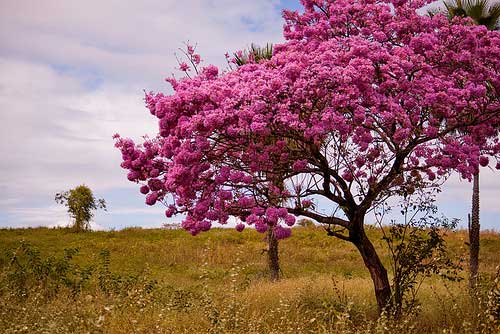
|


© 2011 R.J.Whelan Ltd